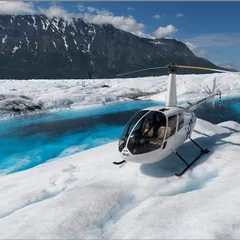
The landing
Alaska helicopter tour with a glacier landing: what those minutes are like
Every listing prices the flight and almost none of them describe the part that people actually remember. This is what happens in the fifteen to twenty-five minutes between the skids touching down and the rotor starting again, and why it is the whole reason the flight costs what it does.
Quick answer
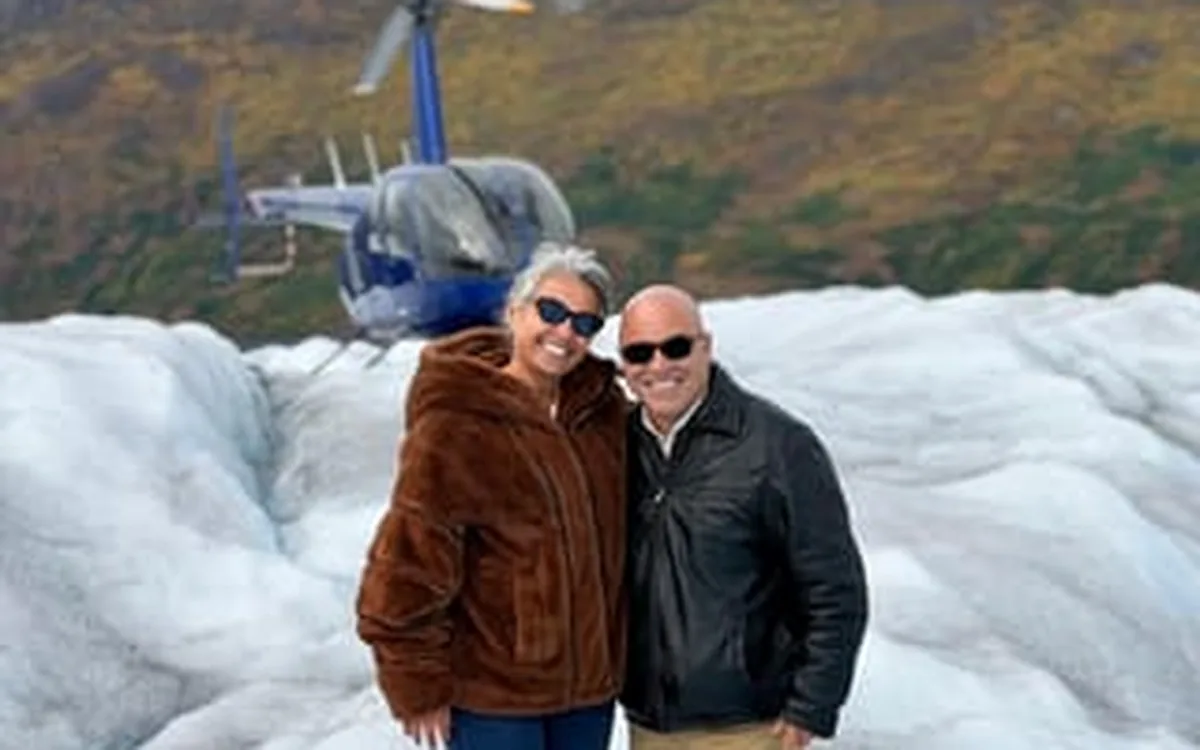
A glacier landing gives you roughly fifteen to twenty-five minutes on the ice with the engine shut down, and it is included on every flight on this page except one, where it is listed as an option. The cheapest flight with a landing is $492. You stay near the aircraft, you need proper footwear, and the thing people describe first afterwards is not the view but the silence.
A glacier landing, at a glance
- Time on the ice
- 15–25 mintypical on a one-hour flight
- Engine
- Shut downwhich is why it is silent
- Cheapest with a landing
- $492one hour on Knik
- More than one landing
- $718the two-hour Grand Knik
- Where you can walk
- Near the aircraftthe pilot marks the area, and means it
- Footwear
- Closed shoes with gripyou are stepping onto ice
- Optional rather than included
- One trip herethe Talkeetna flight — read the listing
- Snow or bare ice
- Depends on the monthwinter covers the crevasse field
- Weather
- Can cancel the landingeven when the flight itself goes ahead
- Cancellation
- Free to 24 hon all fourteen departures
What the landing actually is
A few seconds of flying, and then something completely different
Seconds of flying, then silence. The silence is what people describe first.
The approach is the part passengers notice as flying: the pilot circles once, looks at the surface, and comes in slowly. The touchdown itself takes seconds and is usually softer than people expect.
Then the engine winds down, and the trip changes character entirely. There is no sound at all. No traffic, no aircraft, no birds, and on a still day no wind. People who have described this to us reach for the silence before they reach for the view, and it is the single most consistent thing in the reviews of these flights.
You step out onto the surface. It is not slippery in the way a frozen pavement is — glacier ice in summer has a rough, granular top layer, and in winter it is under snow. It is still ice, and closed shoes with grip are required rather than suggested.
The pilot will show you where you can walk and where you cannot. That boundary is not theatre: crevasses can be bridged by snow, and meltwater channels run under the surface in summer. Stay inside it.
And then fifteen to twenty-five minutes, which sounds short on paper and is not. People consistently report that it went far faster than expected, which is the argument for deciding what you want to photograph before the skids touch down.
Making the minutes count
Six things to do with twenty minutes
Small decisions, and they are the difference between a memory and a camera roll.
- Stand still for the first thirty seconds
Do not reach for anything. The transition from rotor noise to complete silence is the single most striking part of the trip, and it lasts about half a minute before your ears adjust.
- Decide on one lens before you land
People spend a third of their time on the ice changing lenses and regret it. A wide frame with the helicopter in it says more about scale than a long lens on a serac does.
- Photograph something for scale
Ice has no reference points. A person or the aircraft in the frame is the difference between a photograph that works and a blue abstraction.
- Look down, not just out
The surface underfoot — the granular texture, the meltwater channels, the bubbles trapped in the ice — is more unusual than the panorama and almost nobody photographs it.
- Ask the pilot one question
They fly this ice every day and they know what it did last week. Where the crevasse field moved, how far the terminus has retreated, what the blue means. It is the best value in the twenty minutes.
- Put the camera away for the last two
Stand there. It is the thing you will not be able to reproduce afterwards, and the photographs will be waiting when you land.
The flight without a landing costs turbine rates for a view a fixed-wing aircraft can give you more cheaply. Check the listing before you compare prices.
Which flight is best→When the landing does not happen
Two honest cases, and what each one means
One trip lists the landing as optional. And the pilot always has the last word on conditions.
The listing says optional. On one trip here — the Talkeetna flight over the Alaska Range — a glacier landing is listed as an option rather than included. That is not a trick; mountain landings there depend on conditions at altitude and on what is bookable on the day. Read the listing and, if the landing is the point, book a Knik flight instead.
Weather changes on the way. Occasionally a flight goes ahead and the intended landing zone does not work: cloud on the ice, wind, or a surface the pilot does not like. Pilots will move to an alternative site where there is one, and will not land where they should not. This is the correct decision and it is worth accepting as the price of the activity.
The general rule: cancellations happen, and they are the operator’s call. Every departure on this page cancels free up to 24 hours before, which protects your money. It does not create another day, so book early in the trip rather than on the last morning.
Common questions
Glacier landings, answered
Is a glacier landing worth it?
It is the whole point of the flight. The view from the air you can approximate more cheaply from a fixed-wing aircraft; standing on the ice with the engine off fifty miles from a road you cannot approximate at all.
How long do you get on the glacier?
Fifteen to twenty-five minutes on a typical one-hour flight. The two-hour Grand Knik lands more than once, and the four-hour programmes leave you up there with a guide.
Is it slippery?
Less than people expect — summer glacier ice has a rough granular surface, and in winter it is under snow. It is still ice, and closed shoes with grip are required.
Can you walk around freely?
Within the area the pilot marks out. Crevasses can be bridged by snow and meltwater channels run under the surface in summer, so the boundary is a safety matter rather than a formality.
Do all Alaska helicopter tours include a landing?
Not all. On this page every flight includes one except the Talkeetna trip over the Alaska Range, where it is listed as an option. It is the first thing to check on any listing.
What if the weather stops the landing?
The pilot decides, and will move to an alternative site where there is one. Flights are cancelled outright in low cloud. Everything here cancels free up to 24 hours before, so book early in your trip rather than on your last day.
Go deeper
More on Alaska helicopter tours and glacier landings
What an Alaska helicopter tour costs
Fourteen trips priced per person and per hour, from $310 to $1,385.
Knik GlacierThe Knik Glacier flight
The one-hour flight with a landing: what the hour contains and why it costs what it does.
VerdictThe best Alaska helicopter tour
Fourteen trips ranked for one decision, with a straight answer at the end.
AnchorageHelicopter tours from Anchorage
Everything that flies within an hour of the city, and where each one departs.
Grand KnikThe Grand Knik tour
Two hours and more than one landing - what the extra hour actually buys.
Dog sleddingHelicopter and dog sledding
A working kennel on the snow in July, and the only way to reach it.